


Two fascinating things happened last week. Well, in design software. We’ll focus on b2b design software for the next few minutes, shall we? (I have simple interests, my dear readers.)
One, Adobe joined Bluesky to pal it up with artists and posted this message..
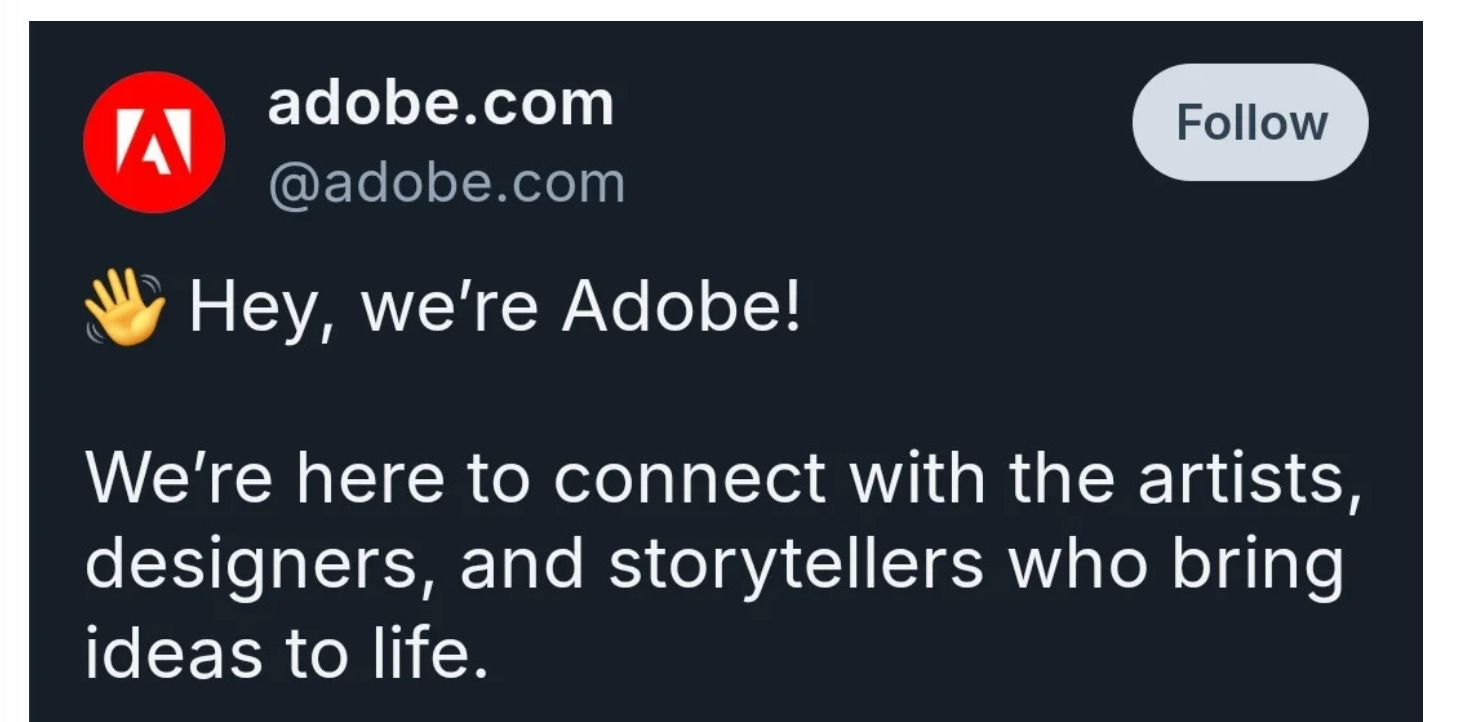
..to instantly get 50 likes and thousands of angry comments and reposts blasting them for overcharging users and embracing AI. The ratio was brutal. They shut the account down. RIP Adobe social media intern.
Only a couple of days later, Canva launched Canva Code, which has been received enthusiastically by their customer base. Since they launched their first generative AI text-to-image feature in 2022, they have grown their customer base a whopping 60%+ from ~130M to 220M MAUs and gone upmarket to enterprise, surpassing $3B in ARR.

Now, this is not to say that Adobe Creative Cloud isn’t growing - it is, at a steady ~10% yoy contributing ~ $12.7B in annual revenue in FY 2024.
However, it’s clear that between these two companies, one feels the innovator’s dilemma intensely and the other does not. What’s going on?
[Subject] Intro: Christensen, meet Einstein
It turns out that Clayton Christensens’ theory of innovative disruption requires an addendum for sweeping technological changes like generative AI and reasoning models. This addendum is your customer’s frame of reference or “bezugssystem” as Albert Einstein called it.
The same technology in the same industry can have different applications that are either sustaining or disruptive based on your customer’s frame of reference.
Adobe’s Illustrator and Photoshop tools are used by professional, freelance artists. The newly launched generative AI features (like Fill, and Recolor) might save them time and make them more productive, but overall, generated images will vastly reduce the economic value of their labour and current skill set. There is no doubt about it. There’s the additional disrespect that it was invented by ignoring the copyright protection of their communal work in the first place. Hence, as the honourable Clay-Clay would say, adding AI to Adobe tools, makes it an inferior product for many of its current customers.
Canva, on the other hand, wants to help everyone be a designer. They can harness the exact same technology to help their customers, many of whom are amateur designers and artists, increase the economic value of their labour and improve their current skill set - making it a sustaining innovation for the business. This is why zero unicorn AI startups are currently competing directly with Canva.1
That doesn’t mean there isn’t an opportunity for startups in design, quite the opposite! The goal of this analysis is to help AI software founders navigate positioning. When do you compete directly with someone vs similarly to them - positioning as “the better X” vs positioning as the “X for you”?2
A great place to start reading about positioning my first post in this newsletter:

So, Canva is democratizing a very particular type of design. Could AI help do the same in gaming? For interiors? In fashion? The sky’s the limit.
Similarly, Adobe and Autodesk are severely constrained by already being maximally upmarket and multi-product. It’s impossible for them to innovate well without cannibalizing themselves - ripe territory for startups (including one I’m on the board of - Vizcom). For Adobe to help its customers increase their economic value and frame an innovator’s solution, it needs to start helping them go further up the value chain in video - but it has no data advantages there to innovate with. It is as disadvantaged as any startup compared to say, Google.
This is why AI is both a disrupting and sustaining innovation for Google at the same time. It is disrupting Google’s search business in the most unique way - “AI Answers” is an inferior product for its advertisers,3 but a better experience for consumers. At the same time, Gemini will make Google Workspace and Android more powerful for their customers and increase subscription revenue for Alphabet. They also own ~70% of Waymo, the first company to commercialize AI for full self-driving, which will eventually be spun out for a massive IPO.
But hold on! Christensen also says that eventually, a disruptive startup goes upmarket and serves the customers of the incumbent, the same ones who rejected the early disruptive product, with something that got better over time.
I believe that this “something better” will likely be the transformative AI-native era of software that hasn’t even begun to be born yet. We are at the -1 stage of that AGI era and the transformer architecture might not get us there. It is possible the defining AGI startup of our generation hasn’t been born yet.
In the meantime, are there lessons to learn from Canva and Adobe in other industries? Undoubtedly. The most important one is to think from first principles instead of blindly copying competitors - what’s true for them might just not be true for you because your customers have a different frame of reference. And this concept applies at every level - from your company strategy to your UX choices.
For instance, look at the product strategy being pursued by Github Copilot vs say Replit Agent. The former works with a local VSCode IDE and started with an autocompletion UX while the latter is a cloud-based, end-to-end SWE agent that includes hosting. The former targets more experienced, professional developers who have an existing code base that they want to try Copilot on while the latter targets younger, aspirational developers starting new projects with a fresh idea.
Their customers have a different frame of reference for AI. Copilot is a sustaining innovation for Github. Replit’s Agent is a disruptive innovation for aspiring developers around the world.
I guess you could count Midjourney though I would argue that’s eating Adobe customer lunch money, not Canva subscriptions
Should I run a Maven course on saas Positioning? Restack to vote yes.
Wait, did you think you, the consumer were Google Search’s customers?